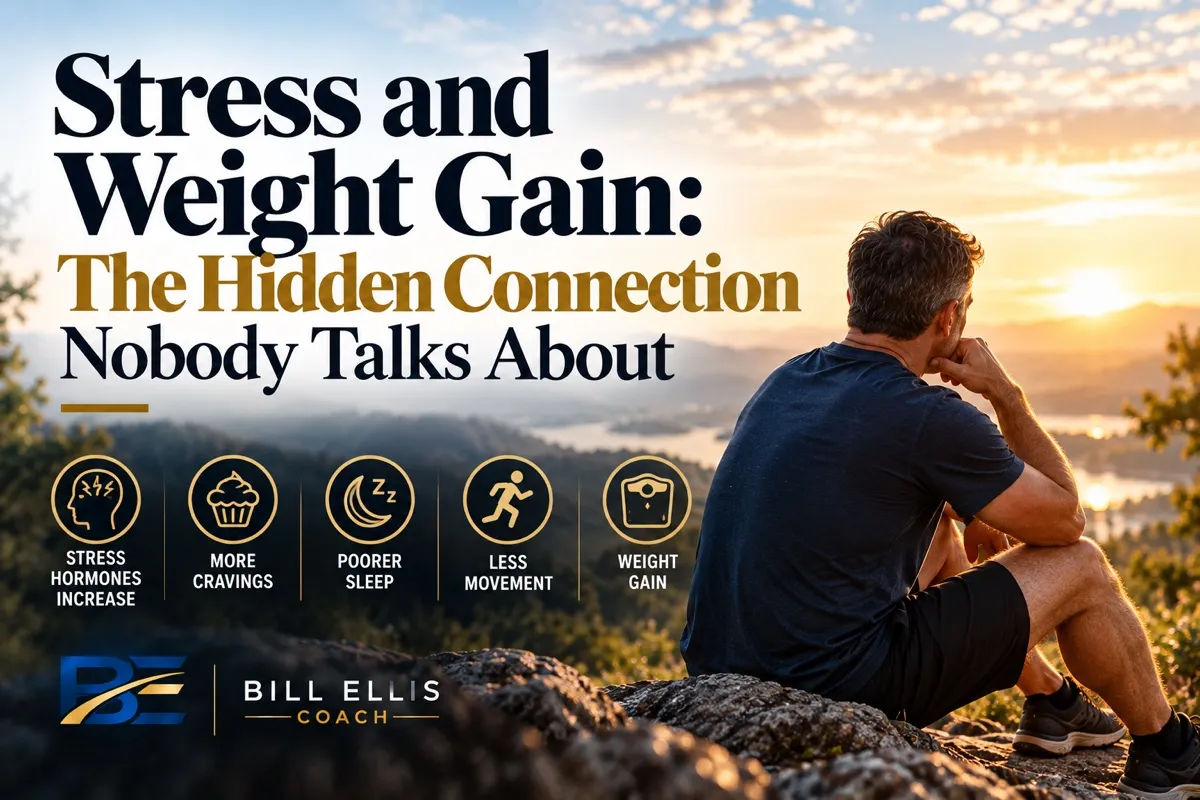
Stress and Weight Gain: The Hidden Connection Nobody Talks About
You’re eating better. You’re moving more. You’re doing the things you’re supposed to do. And the scale still won’t budge, or it keeps creeping up.
Before you decide you’re failing, consider a variable that doesn’t show up on a meal plan: stress. It’s the hidden connection nobody talks about, and it’s one of the most common ones I see.
What Stress Does Inside Your Body
When you’re under pressure, your body releases stress hormones, including cortisol. In short bursts that’s useful. It’s how you slam the brakes when a car pulls out in front of you. The trouble starts when the pressure never lets up: the job, the bills, the kids, the news, the unanswered text.
Research has linked stress to where we carry weight. In a well-known study of 59 healthy women, those who carried more fat around the middle released more cortisol in response to laboratory stress, and they also reported more chronic stress in their lives. That study can’t tell us which came first, and later research has been mixed, so I won’t claim that cortisol is the one cause of belly fat. What it does tell us is that stress and body fat are connected in ways a calorie count can’t see.
Why Stress Makes You Crave Comfort Food
You may have noticed that stress rarely sends you looking for broccoli. Research in animals offers one explanation. Scientists at UCSF proposed that tasty, calorie-rich food may actually dampen the body’s stress response, which could help explain why stressed people reach for it. That work was done in rats, so it’s a model rather than a verdict on humans. But it matches what many of us have felt: the cookie really does seem to take the edge off, for a while.
That’s not weakness. It’s your body looking for relief. The goal isn’t shame. It’s finding relief that doesn’t cost you your health.
The Chain Reaction Behind the Scale
Stress doesn’t only work through hormones. It also changes what we do:
Sleep suffers. A busy, anxious mind makes for short, restless nights. (See Why Sleep Matters for Fat Loss for what that does to hunger and cravings.)
Movement drops. When you’re drained, the walk or the workout is the first thing to go.
Eating gets automatic. Late-night snacking, skipped meals followed by a big one, and drinking calories become the coping tools.
Alcohol creeps in. It feels like unwinding, and it adds calories and wrecks sleep.
I remember when Wendy and I got laid off from our ministry in Chicago, it was the first time that I was jobless since I was fourteen years old. There I was staring at 50 with no job, and no prospects. I found myself stress eating coffee, chocolates, and Doritos while driving Uber and making phone calls to everyone I knew. I allowed the stress of the moment win the day and my habits and health suffered. I am convinced that my greatest error was the belief that I alone was responsible for getting my family out of our situation. I am not saying that I shouldn't have done everything in my power to look for a job and take care of my family, but I am saying that that burden was not mine to carry by myself to the detriment of my mental and physical health.
A Biblical Perspective: You Were Not Meant to Carry It Alone
Scripture speaks to stress directly, and it doesn’t tell us to just try harder.
“Do not be anxious about anything, but in every situation, by prayer and petition, with thanksgiving, present your requests to God” (Philippians 4:6).
“Cast all your anxiety on him because he cares for you” (1 Peter 5:7).
“Come to me, all you who are weary and burdened, and I will give you rest” (Matthew 11:28).
Notice what these verses have in common. They invite us to hand something over. Prayer is not a replacement for a plan, but a plan without it is a lot heavier to carry.
Five Ways to Stress-Proof Your Health
Guard your sleep. Pick a bedtime and protect it like an appointment.
Take a daily walk. Ten to twenty minutes outside is a simple, repeatable way to lower the pressure. See How Walking Can Add Up to 10 Years to Your Life.
Name the trigger before you eat. Ask yourself: am I hungry, angry, lonely or tired? Many recovery programs use the shorthand HALT for exactly this. If you aren’t hungry, take five minutes and pray, call someone, or step outside before you decide.
Build a stress-ready kitchen. Keep protein and ready-to-eat vegetables within reach, so a hard day doesn’t default to the drive-through.
Tell someone. Stress shrinks when it’s shared. A friend, a small group, a coach or a counselor can carry part of it with you.
When to Get More Help
If stress feels constant, if you’re struggling with anxiety or low mood, or if you’re gaining weight quickly alongside symptoms like extreme fatigue, see your doctor or a licensed counselor. Some medical conditions, including thyroid problems, can look like “just stress.” Getting checked is a wise step, not a failure of faith.
Final Thoughts
Your weight isn’t only a math problem. For many of us it’s also a stress problem, and a heart problem. When you care for the stress, the habits get easier, and the scale tends to follow.
So, what’s one thing that’s weighing on you this week, and who can you tell?
Ready to turn this into a habit? The Temple Builders 28-Day Metabolic Reset gives you four weeks of simple daily habits, a Team Leader beside you, and a Day 0 and Day 28 assessment so you can see the change. Join the Reset, or start with the free Metabolic Age scan.
Sources
Epel E, et al. Stress and body shape: stress-induced cortisol secretion is consistently greater among women with central fat. Psychosomatic Medicine, 2000.
Dallman MF, et al. Chronic stress and obesity: a new view of “comfort food”. Proceedings of the National Academy of Sciences, 2003.
Scripture quotations are from the NIV. This article is for education and is not medical advice or a substitute for professional care.
